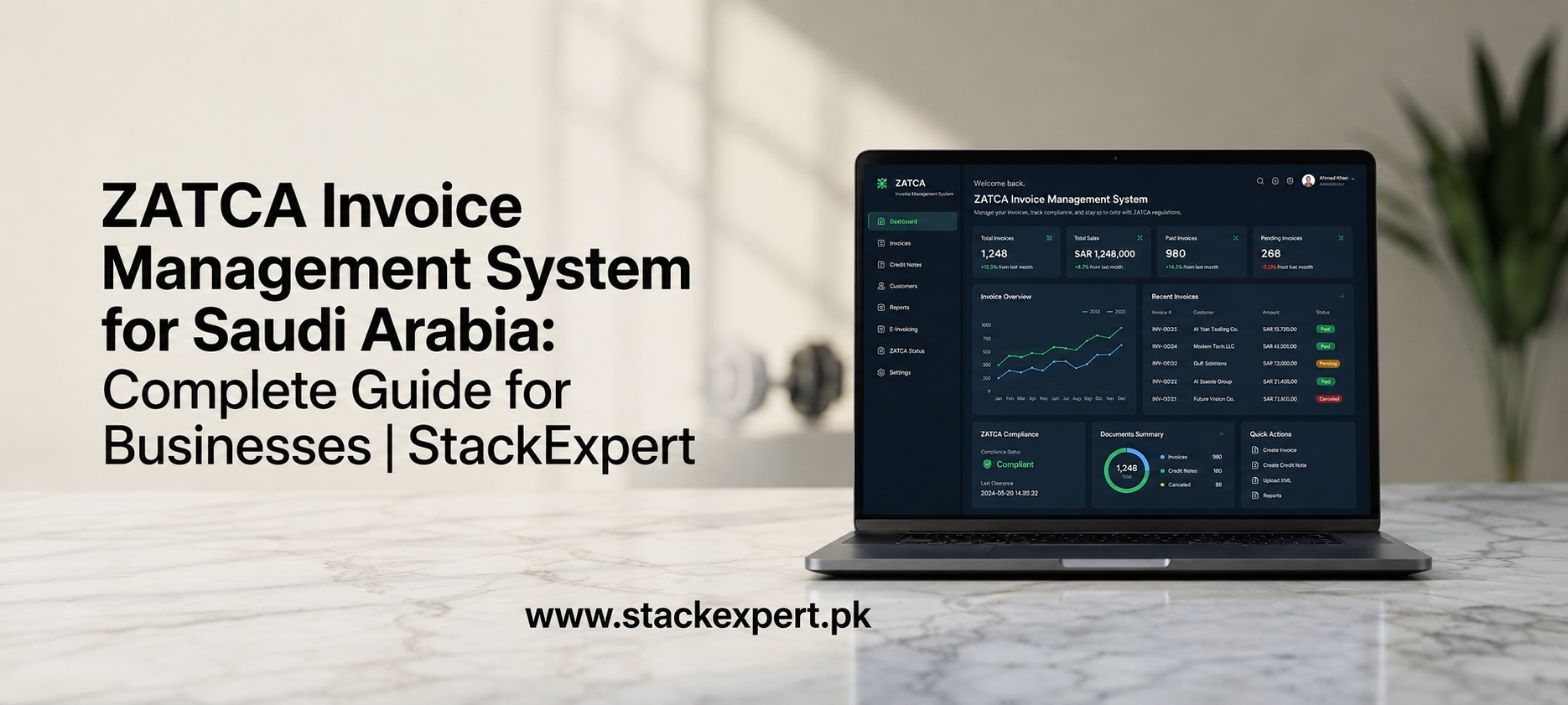

Saudi Arabia is rapidly moving toward a more digital business environment, and invoicing is one of the areas that has changed significantly. With the implementation of ZATCA’s e-invoicing requirements, businesses need reliable digital systems to create, manage, store, and process invoices correctly.
This is where a ZATCA Invoice Management System becomes important. For Saudi businesses, the right invoicing system is not just about replacing paper invoices with digital documents. It can help streamline financial operations, reduce manual work, improve invoice accuracy, and support the applicable requirements of the Zakat, Tax and Customs Authority (ZATCA).
At StackExpert, we understand that businesses need practical technology solutions that fit into their existing workflows. Whether a company needs e-invoicing software, ERP integration, custom software development, or business process automation, the right technology can make compliance and day-to-day operations much easier.
What Is a ZATCA Invoice Management System?
A ZATCA Invoice Management System is an electronic software solution that helps businesses generate, manage, store, and process invoices according to applicable ZATCA e-invoicing requirements.
ZATCA’s e-invoicing initiative, known as Fatoorah, was introduced in phases. Phase 1, known as the Generation Phase, started on December 4, 2021. Phase 2, known as the Integration Phase, began on January 1, 2023, and is being implemented in waves for targeted taxpayers. One important thing businesses need to understand is that e-invoicing does not simply mean creating a PDF and sending it by email.
Under ZATCA’s framework, an electronic invoice needs to be generated and stored electronically through an electronic system in a structured format. A handwritten invoice or scanned copy of a paper invoice does not qualify as an electronic invoice. This is why businesses need a proper Saudi Arabia e-invoicing system rather than relying on manual documents or basic invoice templates.
Why Do Saudi Businesses Need a ZATCA Invoice Management System?
Compliance is obviously one of the main reasons. But there is more to it. Businesses that process invoices manually often deal with repetitive data entry, calculation errors, missing information, difficult record retrieval, and disconnected financial systems.
As the business grows, these problems can become even harder to manage. A modern ZATCA invoice management software can help bring invoicing activities into a centralized digital workflow.
Depending on the solution, businesses can manage:
- Electronic tax invoices
- Simplified tax invoices
- Credit notes
- Debit notes
- Customer information
- VAT-related information
- Invoice records
- Invoice status
- Financial reports
- Accounting integrations
- ERP integrations
For a growing Saudi company, this can mean fewer manual processes and better visibility across financial operations.
Understanding ZATCA E-Invoicing Phases
Before choosing ZATCA invoicing software, businesses should understand the two major implementation phases.
Phase 1: Generation Phase
Phase 1 requires applicable taxpayers to generate and store compliant electronic invoices and notes using a compliant electronic solution. Businesses need an electronic system that can generate invoices with the relevant information and meet the applicable requirements.
For simplified tax invoices, QR code requirements also apply. This means ordinary Word documents, handwritten invoices, or simple scanned paperwork are not a suitable replacement for an electronic invoicing system.
Phase 2: Integration Phase
Phase 2 takes e-invoicing a step further. Under the Integration Phase, applicable taxpayers need to integrate their electronic invoicing solution with ZATCA’s systems and meet additional technical and business requirements.
ZATCA is rolling out Phase 2 in waves and notifies affected taxpayers before their integration date. For this reason, businesses should think beyond basic invoice generation when choosing software.
A good ZATCA Invoice Management System should be capable of supporting the applicable integration and technical requirements of the business.
Key Features of a ZATCA Invoice Management System
Not every invoicing application is designed for Saudi Arabia’s e-invoicing environment. Businesses should carefully evaluate the capabilities of a solution before investing in it.
1. Electronic Invoice Generation
The system should allow businesses to generate electronic invoices with the required information and appropriate invoice details.
Automation can also reduce the amount of information employees need to enter manually. This helps create a more consistent invoicing process.
2. QR Code Functionality
QR codes are an important part of applicable ZATCA e-invoicing requirements, particularly for simplified tax invoices.
A reliable ZATCA e-invoicing software solution should support QR code generation according to the applicable technical requirements. This should be part of the invoicing workflow rather than something employees have to create manually.
3. Secure Invoice Storage
Businesses generate a significant amount of financial data. Invoices and related documents need to be stored properly and remain accessible when required.
A centralized invoice management system in Saudi Arabia can make it easier for finance teams to search, retrieve, organize, and manage electronic invoice records. This is far more practical than maintaining scattered files across computers, email inboxes, and spreadsheets.
4. VAT and Tax Management
VAT information is an important part of invoicing for businesses operating in Saudi Arabia. A suitable system should support relevant tax information and calculations according to the business’s requirements.
Automated processes can also reduce common data-entry and calculation mistakes.
5. Credit and Debit Notes
Business transactions sometimes change after an invoice has been issued. A customer may receive a refund, a product may be returned, or an invoice may need an adjustment.
A complete ZATCA Invoice Management System should therefore support appropriate credit and debit note workflows.
6. ERP and Accounting Integration
Integration is particularly important for medium-sized and large organizations. If invoicing software is completely separate from accounting or ERP software, employees may have to enter the same information multiple times. That wastes time and increases the possibility of errors.
At StackExpert, we can help businesses explore integration between invoicing platforms and existing ERP, accounting, CRM, inventory, and other business systems. The goal is to create a connected workflow instead of another isolated software application.
How Invoice Automation Can Improve Business Operations
One of the biggest benefits of an automated invoice management system is the reduction of repetitive work. Think about the finance team creating hundreds of invoices every month. Manually entering customer details, calculating totals, checking tax information, sending invoices, and maintaining records can take considerable time. Automation can simplify many of these tasks.
A modern invoice workflow may help businesses:
- Generate invoices faster
- Reduce repetitive data entry
- Minimize common errors
- Track invoice status
- Organize customer records
- Store invoices digitally
- Generate financial reports
- Improve internal workflows
This allows employees to spend less time on repetitive administrative tasks and more time on activities that actually require human attention. And that is where the real business value of e-invoicing starts to become clear.
Improve Financial Accuracy With Digital Invoicing
Manual processes always leave room for human error. A wrong customer name, incorrect VAT calculation, duplicate invoice number, missing information, or incorrect transaction detail can cause unnecessary problems.
A well-configured ZATCA Invoice Management System can introduce automated workflows and validation processes to reduce these risks. For businesses processing a large number of transactions, even a small reduction in errors can save significant time.
Digital invoicing also creates a more consistent process across departments. Instead of every employee following a slightly different invoicing method, businesses can establish one structured workflow.
Better Reporting and Financial Visibility
Another advantage of digital invoice management is better access to financial information. Business owners and managers may want to know:
- How many invoices were issued this month?
- Which invoices are unpaid?
- What is the outstanding receivable amount?
- Which customers have overdue balances?
- How much revenue has been invoiced?
- Which invoices were cancelled or adjusted?
- What are the latest sales trends?
When invoice data is centralized, these questions become much easier to answer. A connected system can also make it easier to generate reports and monitor financial performance. For growing companies, this visibility can support better planning and decision-making.
ZATCA Compliance, Security, and Data Management
E-invoicing is not only about generating invoices. Businesses should also consider how invoice data is stored, accessed, transmitted, and protected.
ZATCA has published technical and security requirements relating to e-invoicing solutions, including invoice specifications, data requirements, and security features.
Therefore, businesses should not select software simply because it has an “e-invoicing” label. The solution needs to be evaluated according to the requirements applicable to the business.
Companies should also consider:
- User access controls
- Data security
- Secure integrations
- Backups
- System reliability
- Data storage
- Software updates
- Technical support
At StackExpert, we focus on building technology solutions around the actual business workflow rather than simply installing another software tool.
How to Choose the Right ZATCA Invoice Management System
Choosing the right invoicing software can have a long-term impact on your business operations. Here are several factors to consider.
ZATCA Compatibility
First, understand which ZATCA requirements apply to your business. The software should support the relevant e-invoicing requirements and applicable implementation phase.
Business Requirements
A small company and a large enterprise will not necessarily need the same solution. Consider your invoice volume, number of users, locations, services, customers, and existing financial systems.
Scalability
Your invoicing requirements may increase as the business grows. Choose a system that can handle higher transaction volumes without creating unnecessary limitations.
Integration
If your company already uses an ERP, accounting platform, CRM, inventory software, or other business applications, check whether the invoice management system can integrate with them.
Ease of Use
Software should make work easier, not more complicated. A clean interface and straightforward workflow can improve employee adoption and reduce training requirements.
Security
Invoice information is sensitive financial data. Evaluate access controls, security features, backups, hosting arrangements, and data protection before choosing a solution.
Support
Technology implementation does not end when the software goes live. Businesses may require integration support, updates, troubleshooting, customization, and employee training.
Having a reliable technology partner can make the process much smoother.
Why StackExpert for ZATCA Invoice Management Solutions?
Choosing the right software is only one part of digital transformation. Businesses also need a technology partner that understands how the system needs to fit into their existing operations.
StackExpert provides technology and digital solutions designed to help businesses improve their workflows, automate repetitive processes, and build more connected systems.
For companies looking for a ZATCA Invoice Management System, StackExpert can support areas such as:
- ZATCA-focused e-invoicing solutions
- Custom invoice management software
- ERP integration
- Accounting software integration
- Business process automation
- Cloud-based software solutions
- Custom software development
- Invoice workflow automation
- Business reporting systems
- Data management
- System maintenance and technical support
Our approach can be tailored according to the business. A small organization may need a simple cloud-based invoicing solution, while a larger company may require a customized platform integrated with its ERP, accounting, CRM, and inventory systems.
Instead of forcing every business into the same setup, the focus should be on finding a solution that actually fits.
Why Businesses Should Prepare Early
E-invoicing can affect several parts of a business. The finance team may need new processes. The IT team may need to manage integration. Employees may need training. Management may require improved reporting. Existing ERP or accounting software may need configuration.
Trying to make all these changes at the last minute can create unnecessary pressure.
A better approach is to review the current invoicing process, identify technical gaps, evaluate suitable software, test integrations, and train employees before problems become urgent. Early planning also gives businesses time to identify data or workflow issues.
Conclusion
A ZATCA Invoice Management System can be much more than a compliance tool. For Saudi businesses, it can become an important part of financial automation, helping organizations manage invoices more efficiently, reduce manual work, improve data accuracy, and gain better visibility into financial operations.
The key is choosing a solution that matches both the applicable ZATCA requirements and the actual needs of the business. Whether you need ZATCA e-invoicing software, invoice automation, ERP integration, accounting integration, or a customized business solution, StackExpert can help you explore the right technology approach.
Digital invoicing does not have to be complicated. With the right system and implementation strategy, businesses can turn a regulatory requirement into an opportunity to build a faster, more organized, and more scalable financial workflow.
Frequently Asked Questions
Q1. What is a ZATCA Invoice Management System?
A ZATCA Invoice Management System is software designed to help businesses generate, manage, store, and process electronic invoices according to the applicable ZATCA e-invoicing requirements.
Q2. Is ZATCA e-invoicing mandatory in Saudi Arabia?
ZATCA e-invoicing requirements apply to persons subject to the E-Invoicing Regulation. The implementation has been introduced in phases, with Phase 1 beginning in December 2021 and Phase 2 beginning in January 2023 and continuing through implementation waves.
Q3. What is ZATCA Phase 1?
Phase 1, known as the Generation Phase, requires applicable taxpayers to generate and store compliant electronic invoices and notes using an electronic solution that meets the applicable requirements.
Q4. What is ZATCA Phase 2?
Phase 2, known as the Integration Phase, requires applicable taxpayers to integrate their e-invoicing solution with ZATCA systems and comply with additional technical and business requirements.
Q5. Can a ZATCA Invoice Management System integrate with ERP software?
Yes. Depending on the platform and business requirements, invoice management software can be integrated with ERP, accounting, CRM, inventory, and other business systems.
Q6. What are the benefits of using a ZATCA Invoice Management System?
Benefits can include improved invoice processing, reduced manual data entry, better financial accuracy, easier record management, automated workflows, improved reporting, and support for applicable ZATCA e-invoicing requirements.
Q7. Can StackExpert provide ZATCA invoice management solutions?
Yes. StackExpert can support businesses with ZATCA-focused e-invoicing solutions, custom software development, ERP and accounting integrations, workflow automation, and other business technology solutions based on their requirements.